
|

|

|

|

|

|

|
8.2.2 Employment practice unions
Providence University is committed to ensuring the fundamental rights and interests of all faculty and staff members, including contract-based personnel, in areas such as employment security, fair compensation, and working conditions, while fostering a harmonious campus environment. In alignment with the principles of equal educational opportunity outlined in the Fundamental Education Act, the university upholds respect for diversity in gender, nationality, and ethnicity. Faculty and staff, including women and international members, are actively recognized and encouraged to participate in various institutional meetings and committees—such as the University Council, the Teacher’s Appeal Review Committee, the Staff’s Appeal Review Committee, and labor-management meetings—to promote democratic engagement and transparent governance in education.
To strengthen mechanisms for grievance and redress, Providence University has established the Teacher’s Appeal Review Committee and the Staff’s Appeal Review Committee. These measures provide formal channels for faculty and staff to file complaints and seek fair review in cases of unjust treatment or infringement of rights. This system not only aligns with Article 15 of the Fundamental Education Act, which protects teachers’ professional autonomy, but also responds to Article 74 of the Labor Standards Act, which guarantees workers’ rights to lodge complaints.
In accordance with the Labor Standards Act and related labor regulations, Providence University conducts regular labor-management meetings to facilitate communication and coordination between employers and employees. These meetings address issues such as working conditions, employee benefits, workplace improvements, and efficiency enhancement, thereby ensuring the protection of basic labor rights. This practice contributes to the promotion of labor-management cooperation and the establishment of a stable and harmonious working environment on campus.
Providence University continues to advance labor justice on campus through a foundation of legal compliance, striving to create a diverse, equitable, and respectful workplace where all faculty and staff can work with peace of mind and grow with confidence.
Teacher’s Appeal Review Committee
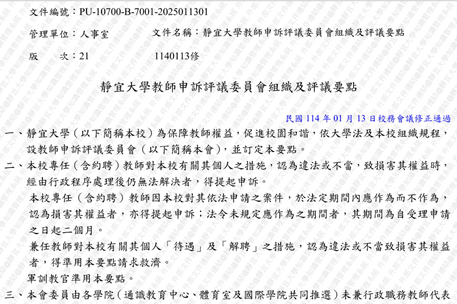 |
Full-time faculty members who believe the university has acted illegally or improperly, resulting in harm to their rights, and who find that the issue remains unresolved through administrative procedures, may file an appeal. Similarly, part-time faculty who feel that actions related to their "treatment" or "dismissal" are unjust or illegal, causing a violation of their rights, can seek relief through the Teacher Appeal Review Committee. |
Staff’s Appeal Review Committee
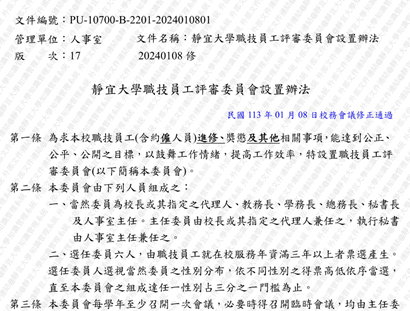 |
In order to safeguard staff/contracted labor rights, any staff member who feels that the university's administrative decisions or actions have negatively impacted their personal rights, and are unable to resolve the issue through coordination with relevant departments, may submit an appeal to the Staff Appeal Review Committee. |
- Employer Representatives: President or a designated proxy, Dean of Academic Affairs, Dean of Student Affairs, Dean of General Affairs, Secretary-General, Director of Office of Accounting Office and Director of Office of Personnel
- Employee Representatives: Elected through an open ballot, with seven representatives chosen. At least half of the employee representatives must be of the same gender.