|
2022
|
2023
|
2024
|
|
55
|
53
|
53
|
|
Academic Year
|
Activities
|
Sessions
|
|
2022
|
Future Design Dream Book Guidance Workshop |
4
|
|
2023
|
Future Design Dream Book Guidance Workshop |
11
|
|
2024
|
Self-Life History Writing Guidance Workshop
|
8 |
| Future Design Dream Book Guidance Workshop |
10
|
Since the 2022 academic year, Providence University has actively cultivated the “Future Leaders Narrative Student Team.” To date, the initiative has successfully recruited 51 members. Through designed courses and assignments, students are guided to integrate reading and writing skills with their academic disciplines, while connecting to the United Nations Sustainable Development Goals (SDGs), thereby putting knowledge theory into practice through social engagement. Students independently plan thematic exhibitions and produce podcast programs, demonstrating their proficiency in interdisciplinary learning and civic participation.
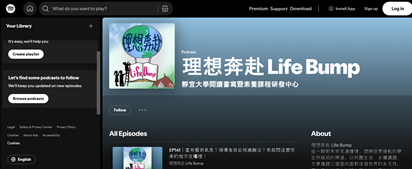
Among these initiatives, the student-produced podcast series Life Bump: Pursuing Ideals has released 174 episodes, accumulating over 4,000 total listens. The series cover wide range of topics such as traditional folk customs, medical and disease-related regulations, ecological sustainability, educational opportunities, and social inclusion. These themes correspond to SDG 3 (Good Health and Well-being), SDG 4 (Quality Education), SDG 5 (Gender Equality), SDG 10 (Reduced Inequalities), and SDG 11 (Sustainable Cities and Communities).
Micro-credit courses align with the United Nations Sustainable Development Goals (SDGs)
To enhance course quality and learning flexibility, Providence University launched a Micro-Credit Course Pilot Program in 2016. Designed around the concept of “small but impactful” learning courses, the program integrates the university’s six core development areas—Information, Service, Internationalization, Communication, Creativity, and Employability. These micro-courses offer diverse, hands-on learning experiences such as workshops, practical training, lectures, site visits, and mock interviews, closely aligned with industry practices. Students can freely select and combine courses from freshman to senior year, earning one academic credit upon completing 18 hours of participation, thereby expanding the flexibility of credit acquisition.
In the 2024 academic year, the university offered 16 micro-credit courses, among which 6 were specifically aligned with the United Nations Sustainable Development Goals (SDGs). Course topics included career exploration, aging society issues, ecological crises and sustainable development, empathy in gender equality, respect for minority groups, problem-solving in industry, and compassion for life. These themes correspond to SDG 4 (Quality Education), SDG 5 (Gender Equality), SDG 8 (Decent Work and Economic Growth), SDG 10 (Reduced Inequalities), and SDG 15 (Life on Land).
Through these specific courses, Providence University not only strengthens students’ sense of social responsibility and sustainability awareness but also fulfills the vital role of higher education in advancing sustainable development. The university demonstrates its commitment to cultivating globally minded and locally engaged talents prepared to address the challenges of the future.
Since the 2018 academic year, Providence University has implemented a university-wide project-based learning initiative, emphasizing personalized and competency-based instruction. This comprehensive approach spans three key stages—from high school outreach and freshman transition programs to senior capstone projects—providing students with guided learning experiences tailored to their academic progression.
These innovative models include exploratory micro-project courses and customized curricula that integrate SDG-related themes and sustainability issues. Designed to cultivate creativity and soft skills among first-year students, the program also offers diverse learning resources aligned with students’ academic levels and developmental needs.
During the 2023–2024 academic year, the university offered a range of courses directly addressing SDGs and sustainability topics. These included ecological and environmental issues, the application of AIoT technologies in fire alarm systems and temperature alert platforms, human rights and legal concepts, aquatic ecosystems, coastal wetland conservation, and green chemistry. These courses correspond to multiple SDGs, such as SDG 3 (Good Health and Well-being), SDG 4 (Quality Education), SDG 6 (Clean Water and Sanitation), SDG 9 (Industry, Innovation and Infrastructure), SDG 13 (Climate Action), and SDG 14 (Life Below Water).
Through this integrative and forward-looking educational framework, Providence University not only enhances students’ academic and professional competencies but also empowers them to become active contributors to global sustainability efforts.